 Tokyo Photoshoot
32 Tokyo Photo Spots, Mapped
Most lists of Tokyo photo spots stop at a name and a hero image. This one carries the two things that decide whether you get the frame: the hour the light works, and your legal right to press the shutter at all. Two of Shinjuku's most photographed alleys require the landlord's written permission before any camera comes out, and the garden every concierge service names first bans commercial photography outright. Thirty-two locations below, each with verified coordinates, the walk from the nearest station, and the honest answer to whether any bookable session on this site actually goes there. Eighteen of them are on a package; fourteen are yours alone.
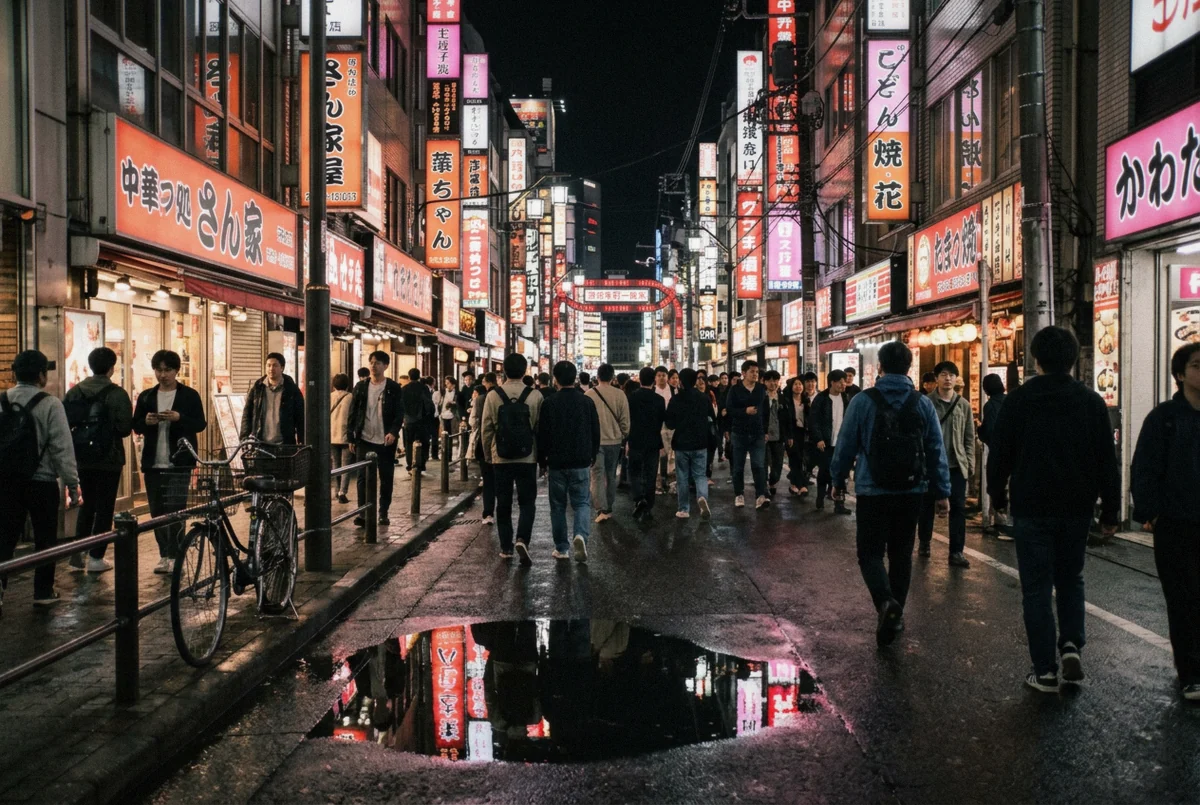
Kabukicho after rain. Wet asphalt is the cheapest lighting upgrade in Tokyo.
Quick answer The short version: which spots, which hour, and which ones say no
Tokyo's photogenic districts sort into four clusters that barely overlap. Shibuya and Harajuku are daytime crowds and giant screens, best at blue hour when the screens are lit and the sky still holds colour. Shinjuku is neon stacked over narrow lanes and only exists after dark. Asakusa is temple architecture that needs to be shot before eight in the morning. Everything else, from Tokyo Tower to the moat at Chidorigafuchi, is a single-frame trip you plan a half day around. The map below carries all thirty-two with their coordinates, and the comparison of sessions says which package covers which district.
Key takeaways
- Omoide Yokocho and Golden Gai both prohibit photography without the alley management's permission, and both appear as stops on bookable sessions
- Shinjuku Gyoen bans commercial photography inside the garden and bars tripods entirely during cherry blossom season
- The busiest spots have a quiet hour: Sensō-ji before 08:00, Shibuya Crossing after 22:00, Takeshita Street before the schools finish
- Fourteen of the thirty-two have no session on them at all, which the session catalogue says plainly rather than pretending otherwise
- Tokyo Tower has two sessions of its own: one photographs you at the Zōjō-ji gate, the other is a guide walking you to viewpoints with your own camera
All 32 Tokyo Photo Spots at a Glance
One row per spot. "On a session" means a bookable photoshoot package names it or works that street. The join comes from the operators' own listings, not from guesswork. Full detail sits under the map.
| Spot | The frame | Best light | From the station | On a session |
|---|---|---|---|---|
| Shibuya Scramble Crossing | Hundreds of people under lit screens | Blue hour, again after 22:00 | At Shibuya Station | Yes: 4 sessions |
| Hachiko statue | The meeting point everyone knows | Overcast midday | 2 min from Hachiko exit | Yes: workshop meets here |
| Shibuya Sky | Rooftop panorama over the crossing | 45 min before sunset | In Shibuya Scramble Square | No session |
| Center-gai | Sign corridor, constant movement | After dark | 3 min from Hachiko exit | Yes: 2 sessions |
| Nonbei Yokocho | Two lanes of tiny bars by the tracks | Just after sunset | 4 min from Shibuya Station | No session |
| Takeshita Street | Harajuku shopfronts and crowd | Before 11:00 | At Harajuku Station | No session |
| Meiji Jingu | Wooden torii, gravel avenue, forest | First hour after opening | 1 min from Harajuku Station | No session |
| Kabukicho Ichibangai | The red gate and the strip behind it | After dark | 5 min from Shinjuku East exit | Yes: 2 sessions |
| Godzilla Head | The head over the Hotel Gracery roofline | After dark, looking up | 6 min from Shinjuku East exit | Yes: 1 session |
| Omoide Yokocho | Lantern alley, grill smoke | From sunset | 2 min from Shinjuku West exit | Yes: 2 sessions, permission rules apply |
| Golden Gai | Six lanes of hand painted bar signs | Late evening | 7 min from Shinjuku East exit | One option only, permission rules apply |
| Shinjuku West crossing | Camera stores, traffic, office towers | Blue hour | At Shinjuku West exit | Yes: 3 sessions |
| Cross Shinjuku 3D cat | A calico cat on a curved screen | Full dark | 1 min from Shinjuku East exit | Yes: 1 session meets here |
| Shinjuku Gyoen | Lawns, ponds, Japanese garden | Late afternoon | 5 min from Shinjuku-gyoenmae | No session, commercial shooting banned |
| Metropolitan Government Building | Free 202 m observatory | Sunset to blue hour | 10 min from Shinjuku West exit | No session |
| Kaminarimon | Great gate, giant red lantern | Before 08:00 | 1 min from Asakusa Station | Yes: 2 sessions |
| Sensō-ji main hall | Temple hall and five storey pagoda | Before 08:00 | 8 min from Asakusa Station | Yes: 2 sessions |
| Nakamise-dōri | Shopping street to the temple | Before 08:00, shutters painted | 3 min from Asakusa Station | Yes: 2 sessions |
| Asakusa Culture Centre terrace | Free view down Nakamise | Late afternoon | Opposite Kaminarimon | No session, no tripods |
| Hoppy Street | Open air tables, red lanterns | From 16:00 | 10 min from Asakusa Station | No session |
| Sumida Park riverside | River, cherry trees, Skytree behind | Late afternoon | 5 min from Asakusa Station | Yes: longer packages only |
| Tokyo Skytree | 634 m tower, close or framed | Blue hour | At Oshiage Station | No session |
| Tokyo Tower | The orange lattice tower itself | Blue hour, lit until midnight | 5 min from Akabanebashi | Yes: 2 sessions |
| Akabanebashi crossing | The tower standing over a road | Blue hour | At Akabanebashi Station | Yes: 1 session meets here |
| Chidorigafuchi | Moat, boats, cherry canopy | Early morning in bloom week | 5 min from Kudanshita | No session |
| Nezu Shrine | Tunnel of small vermilion torii | Morning, weekday | 5 min from Nezu Station | No session |
| Yanaka Ginza | Old shopping street, sunset steps | One hour before sunset | 5 min from Nippori | No session |
| Kagurazaka | Cobbled slopes, stone alleys | Late afternoon | 3 min from Iidabashi | No session |
| Rainbow Bridge and Odaiba | Bridge, bay, city skyline | Blue hour from the Odaiba side | 12 min from Odaiba-kaihinkoen | No session |
How Much Tokyo Do You Have?
If you have one evening
stay in Shinjuku. Kabukicho's gate, the Godzilla head, the lantern alley and the west side crossing sit inside a fifteen minute walk of each other, and all four only work after dark
If you have one morning
take Asakusa before eight. Kaminarimon, Nakamise with the shutters still down, the main hall and the pagoda, then the riverside at Sumida Park while the light is still soft
If you have a full day
Asakusa at dawn, Yanaka or Nezu mid morning, Shibuya in the afternoon, then blue hour at Akabanebashi under Tokyo Tower. The hour by hour plan runs exactly this
If Tokyo Tower is the photograph you came for
the tower has its own pair of sessions, one that photographs you at the Zōjō-ji gate and one that walks you to the viewpoints with your own camera
If you are here in cherry blossom week
Chidorigafuchi at first light and Sumida Park in the afternoon, and expect tripod restrictions at Shinjuku Gyoen for the whole period
If you want to be in the photographs rather than take them
the session comparison lines up all fourteen bookable options by district, length and how many edited photos come back
The Map: 32 Spots and Who Shoots Them
Bubble size follows the number of bookable sessions that reach a spot, so the map shows where the photography industry actually concentrates. Small circles are the ones you shoot alone. Search by a spot name, a district or a session name; the list below the map carries every entry in full.
Every Spot in Full
The same thirty-two entries the map draws, with the walk, the hour that works and the sessions that reach them.
-
Shibuya Scramble Crossing
4 of the toursSeveral hundred people crossing in every direction under screens the size of buildings. The most photographed intersection in the world, and still worth it at the right hour.
Stops here: Shibuya neon hour, $117, Daytime portrait tour, $80, Shibuya Crossing, $134, Photography workshop, $50
-
Hachiko Statue
1 of the toursThe bronze dog every Tokyo meeting starts at. A short queue forms for the photograph, and the plaza around it is the busiest people watching in the city.
Stops here: Photography workshop, $50
-
Shibuya Sky Rooftop
No tourAn open rooftop 229 m above the crossing, with the city running to Mount Fuji on a clear day. Tickets are timed and sunset slots sell first.
No guided tour stops here. Self-drive only.
-
Center-gai
2 of the toursThe pedestrian corridor behind the crossing: signage on every floor, a crowd that never thins, and shopfront light bright enough to shoot handheld after dark.
Stops here: Shibuya neon hour, $117, Daytime portrait tour, $80
-
Nonbei Yokocho
No tourTwo lanes of bars barely wider than a doorway, pressed against the railway embankment. Shibuya's answer to Omoide Yokocho, and far less photographed.
No guided tour stops here. Self-drive only.
-
Takeshita Street
No tourFour hundred metres of crepe stands, thrift shops and teenagers. The colour is the point, and so is the density: it is shoulder to shoulder from late morning.
No guided tour stops here. Self-drive only.
-
Meiji Jingu
No tourA cypress torii twelve metres high, then a gravel avenue through forest to the shrine. Wedding processions cross it on weekend mornings.
No guided tour stops here. Self-drive only.
-
Kabukicho Ichibangai
2 of the toursThe red arch over Shinjuku's nightlife grid, with signage stacked eight floors up behind it. The single densest neon frame in the city.
Stops here: Shinjuku cyberpunk, $85, Kabukicho neon hour, $107
-
Godzilla Head
1 of the toursA life sized Godzilla head looking down from the eighth floor terrace of the Hotel Gracery. Shot from the street below, it reads as the monster over the rooftops.
Stops here: Kabukicho neon hour, $107
-
Omoide Yokocho
2 of the toursA post war lane of yakitori counters beside the station, lanterns and grill smoke in the same frame. Also private property: the alley's management prohibits photography and video without prior permission, and approved shoots wear an armband with a staff chaperone.
Stops here: Shinjuku cyberpunk, $85, Instax night shoot, $76
-
Golden Gai
1 of the toursSix lanes of roughly two hundred bars the size of a living room, hand painted signs stacked above each door. No photo signs are posted throughout and shooting needs the business promotion association's approval.
Stops here: Shinjuku cyberpunk, $85
-
Shinjuku West Crossing
3 of the toursThe camera store district: Yodobashi's red signage, taxi ranks, salarymen and office towers, all in one wide frame at the west exit.
Stops here: Shinjuku cyberpunk, $85, Instax night shoot, $76, Kabukicho neon hour, $107
-
Cross Shinjuku 3D Cat
1 of the toursA calico cat that wakes, stretches and yawns on a curved screen above the east exit, on a loop between adverts. Waiting for the cat is part of the shot.
Stops here: Midnight Shinjuku, $35
-
Shinjuku Gyoen
No tourFifty eight hectares of lawns, ponds and a Japanese garden, the first location concierge photography services name for Tokyo. Commercial photography inside the garden is prohibited, groups are capped at ten people including models, and tripods and reflectors are barred entirely during cherry blossom season.
No guided tour stops here. Self-drive only.
-
Metropolitan Government Building
No tourA free observatory 202 m up in the north tower, looking back over Shinjuku's skyline and out to Mount Fuji on clear winter days. Glass reflections are the enemy: bring a dark jacket and shoot with the lens against the pane.
No guided tour stops here. Self-drive only.
-
Kaminarimon
2 of the toursThe great outer gate of Sensō-ji and its four metre red lantern, guarded by the thunder and wind gods. Nearly every kimono photograph taken in Tokyo starts here.
Stops here: Asakusa kimono, from $21, Asakusa temple shoot, $91
-
Sensō-ji Main Hall and Pagoda
2 of the toursTokyo's oldest temple, with the five storey pagoda to the left of the hall and incense smoke drifting across the courtyard. Empty at first light, crowd managed by mid morning.
Stops here: Asakusa kimono, from $21, Asakusa temple shoot, $91
-
Nakamise-dōri
2 of the toursTwo hundred and fifty metres of stalls between the outer gate and the temple. Before opening, the painted shutters make a corridor of colour with nobody in it.
Stops here: Asakusa kimono, from $21, Asakusa temple shoot, $91
-
Asakusa Culture Centre Terrace
No tourA free eighth floor terrace directly opposite Kaminarimon, looking straight down the length of Nakamise to the temple. Tripods are not allowed and you shoot over the fence.
No guided tour stops here. Self-drive only.
-
Hoppy Street
No tourOpen air tables and red lanterns two streets west of the temple, filled from late afternoon. The most animated daylight frame in Asakusa, and the least photographed.
No guided tour stops here. Self-drive only.
-
Sumida Park Riverside
1 of the toursAn open embankment five minutes from the temple crowds, with cherry trees along the path and the Skytree standing across the water. The contrast frame: old district, new tower.
Stops here: Asakusa temple shoot, $91
-
Tokyo Skytree
No tourAt 634 m the tallest tower in the world, and too big to photograph from its own base. The good frames are from a distance: the Sumida embankment, or the canal at Jikken bridge.
No guided tour stops here. Self-drive only.
-
Tokyo Tower
2 of the toursThe orange lattice tower from 1958, lit warm white or orange depending on the season and still the most photogenic structure in the city. Two bookable sessions work it: one photographs you around its base, the other walks you to viewpoints and leaves the camera in your hands.
Stops here: Tokyo Tower shoot, $57, Tower viewpoints walk, $55
-
Akabanebashi Crossing
1 of the toursThe vantage point that makes Tokyo Tower look like it grew out of the road. Stand at the crossing outside the station and the tower rises straight up the centre of the street.
Stops here: Tokyo Tower shoot, $57
-
Zōjō-ji Main Gate
1 of the toursA 400-year-old vermilion gate with Tokyo Tower rising directly behind it. The one composition in the city that puts Edo and the 1950s in the same frame, and the opening stop of the tower session.
Stops here: Tokyo Tower shoot, $57
-
Shiba Park
1 of the toursOpen lawn and tree canopy immediately below the tower, far quieter than the base itself. Upward angles through the branches are what it is used for.
Stops here: Tokyo Tower shoot, $57
-
Atago Shrine
1 of the toursA shrine of fire prevention founded in the early Edo period, reached by a flight of stone steps so steep they are known as the Success steps. Tokyo Tower sits ten minutes downhill.
Stops here: Tower viewpoints walk, $55
-
Chidorigafuchi
No tourThe old palace moat under a canopy of cherry trees, with rowing boats on the water. For one week a year it is the most beautiful place in Tokyo and the most crowded.
No guided tour stops here. Self-drive only.
-
Nezu Shrine
No tourA tunnel of small vermilion torii climbing a hillside, the same idea as Fushimi Inari at a tenth of the scale and a tenth of the queue. Azaleas fill the slope in April.
No guided tour stops here. Self-drive only.
-
Yanaka Ginza
No tourA low rise shopping street in one of the few districts that survived both the earthquake and the war. The steps at the western end line up with the sunset, which is how they got their name.
No guided tour stops here. Self-drive only.
-
Kagurazaka
No tourCobbled slopes and stone alleys behind a main street of French bakeries, the closest thing central Tokyo has to Kyoto's lanes. Quiet enough to work without an audience.
No guided tour stops here. Self-drive only.
-
Rainbow Bridge and Odaiba
No tourThe suspension bridge across Tokyo Bay, best shot from the Odaiba waterfront with the city behind it. The walkway across the bridge is open to pedestrians and free.
No guided tour stops here. Self-drive only.
Shibuya and Harajuku: Crowds as the Subject
Seven of the thirty-two spots sit within a twenty minute walk of Shibuya Station, and they share one problem and one solution. The problem is that the crowd is never going away. The solution is to stop fighting it and photograph it: at the crossing, a subject standing still while several hundred people flow around them is a better picture than the same subject on an empty street, and it is the frame the Shibuya crossing session sells in fifteen to forty five minutes.
Light matters more here than anywhere else in the city. The screens above the crossing are lit from dusk, but until the sky drops to a deep blue they are competing with daylight and the picture flattens. The window is roughly thirty minutes long, from the moment the streetlights come on to full dark, and it is why the hour long Shibuya walk starts after sunset rather than at it. After 22:00 the crowd thins by maybe a third, the screens are still running, and you can stand in the middle of the scramble for a full light cycle without being pushed.
The three frames worth planning around
The crossing from street level, shot wide with your subject stationary. The crossing from above, which means the Shibuya Sky rooftop or the free Starbucks window that has now been rebuilt into Shibuya Tsutaya. And Center-gai's sign corridor, where the walls do the lighting and you can shoot handheld at reasonable settings well after dark.
Harajuku is a different assignment. Takeshita Street is colour and density, best before eleven in the morning before the school crowds arrive, and Meiji Jingu five minutes away is the opposite: gravel, cypress and quiet, with a torii twelve metres high that needs a step back and a longer lens rather than a wide one.
Shinjuku: Where the Neon Is, and Where the Cameras Are Not Welcome
Eight spots, all within a fifteen minute walk, and the highest concentration of bookable sessions on this site. It is also the district where the rules bite. Two of its best known lanes are privately managed and both restrict photography, which is not a footnote when two sessions list them as scheduled stops.
Omoide Yokocho, the lantern lined yakitori alley by the west exit, prohibits all photography and video without prior permission from the alley's management; approved shoots wear a shooting approved armband and are chaperoned by staff. Golden Gai posts no photo signs down every lane and requires the approval of the district's business promotion association, because the people drinking in those two hundred tiny bars come precisely for the discretion. Neither rule is aimed at you personally, and neither is a reason to skip the district. It is a reason to ask the operator how the stop is handled before you book, which is exactly what the cyberpunk neon session page sets out, since Golden Gai appears on its premium option and on its exclusion list at the same time.
What works without any permission at all
The Kabukicho Ichibangai gate is a public street and the densest neon frame in Tokyo. The Godzilla head over the Hotel Gracery is shot from the pavement. The west exit crossing, with Yodobashi's signage and the taxi ranks, is public. So is the 3D calico cat on the curved screen above the east exit, which runs on a loop between adverts and is where one session meets its guests.
And the free observatory in the Metropolitan Government Building, 202 m up, costs nothing and stays open into the evening. It is the cheapest skyline in Tokyo. Bring something dark to drape over the glass, because the reflections of the room behind you are the only real difficulty.
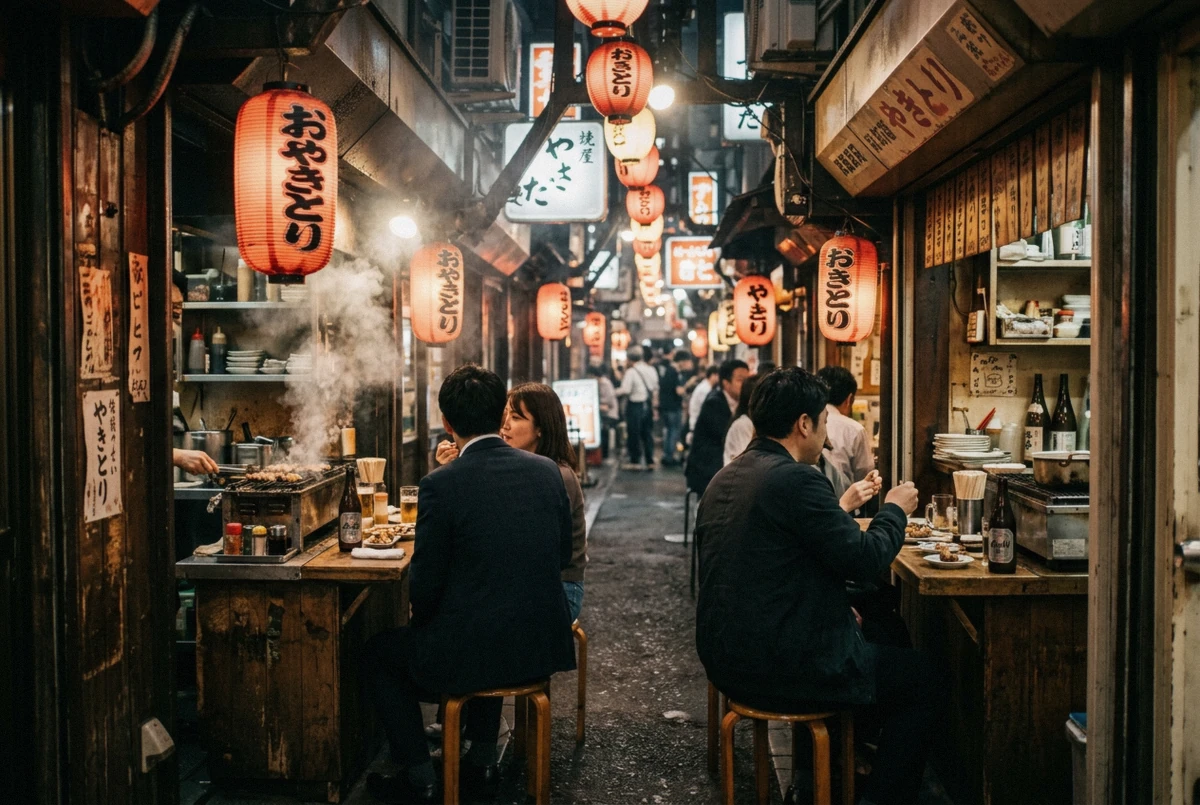
Omoide Yokocho. Beautiful, and off limits to a camera without the alley management's approval.
Asakusa and the River: A Morning District Pretending to Be an All Day One
Seven spots, and the whole cluster runs on one number: eight o'clock. Before eight, Nakamise is a corridor of painted shutters with nobody in it, the light is soft, and the pagoda has clean sky behind it. After ten it is a crowd management exercise, which is why one operator states outright that it routes deliberately around the worst of it.
The temple itself is generous to photographers. There is no blanket tripod ban at Sensō-ji, unlike the terrace across the road at the Culture Centre where tripods are not allowed and you shoot over the fence. What the temple asks for is ordinary courtesy: it is a working religious site with a constant flow of people who came to pray rather than to be in your background.
The river is the half nobody books
Five minutes from Kaminarimon, Sumida Park opens onto the water with the Skytree standing across it and cherry trees along the path. It is the only frame in the district that puts old Tokyo and new Tokyo in the same picture, and it is only reachable on the longer packages of the Asakusa temple and riverside session, which adds it once you book sixty minutes or more.
Hoppy Street, two blocks west of the temple, is the other overlooked one: open air tables and red lanterns filling from four in the afternoon, animated in a way the temple never is. No session on this site shoots it. That is not an oversight in the catalogue, it is what the catalogue actually contains, and the kimono walk is the closest thing since its three hours of dressing and walking leave you free to wander afterwards.
Tokyo Tower: Two Sessions, Four Vantage Points
Tokyo Tower is the most photographed structure in the city, and unlike the rest of this list it is served by two very different bookable sessions. One photographs you around the tower: three stops, starting at the Zōjō-ji main gate where a 400-year-old vermilion gate stands in front of the steel, then Shiba Park, then the tower base on the longer bookings. The other is a guide walking you to three viewpoints and up the steep Success steps at Atago Shrine, with the camera staying in your hands.
Either way the technical part is the same. The tower is lit until midnight, warm white through most of the year, and it holds detail at blue hour while the sky is still deep rather than black. Four vantage points do most of the work: the Akabanebashi crossing, where the tower rises straight up the centre of the road; the Zōjō-ji main hall in front of it, best in the hour before the tower lights come on so the roof still has shape; Shiba Park immediately below, close enough for the legs and the underside; and the Roppongi side, where the tower sits inside the skyline rather than above it.
How to shoot a lit tower without a tripod
Blue hour solves most of it. In the twenty minutes after the streetlights come on, the sky is still bright enough that a handheld exposure at a sensible ISO holds both the tower and its surroundings. Wait for full dark and the gap between the lit tower and the black sky grows wider than a phone sensor can carry, which is when photographs of Tokyo Tower start looking like an orange scribble. The session operator makes the same point from the other direction and suggests booking thirty to forty five minutes before sunset.
One practical note for a portrait under it: the pavements at Akabanebashi are narrow and the traffic light cycle is short. It is a two minute window each cycle, repeated as often as you like, rather than a place you can set up in.
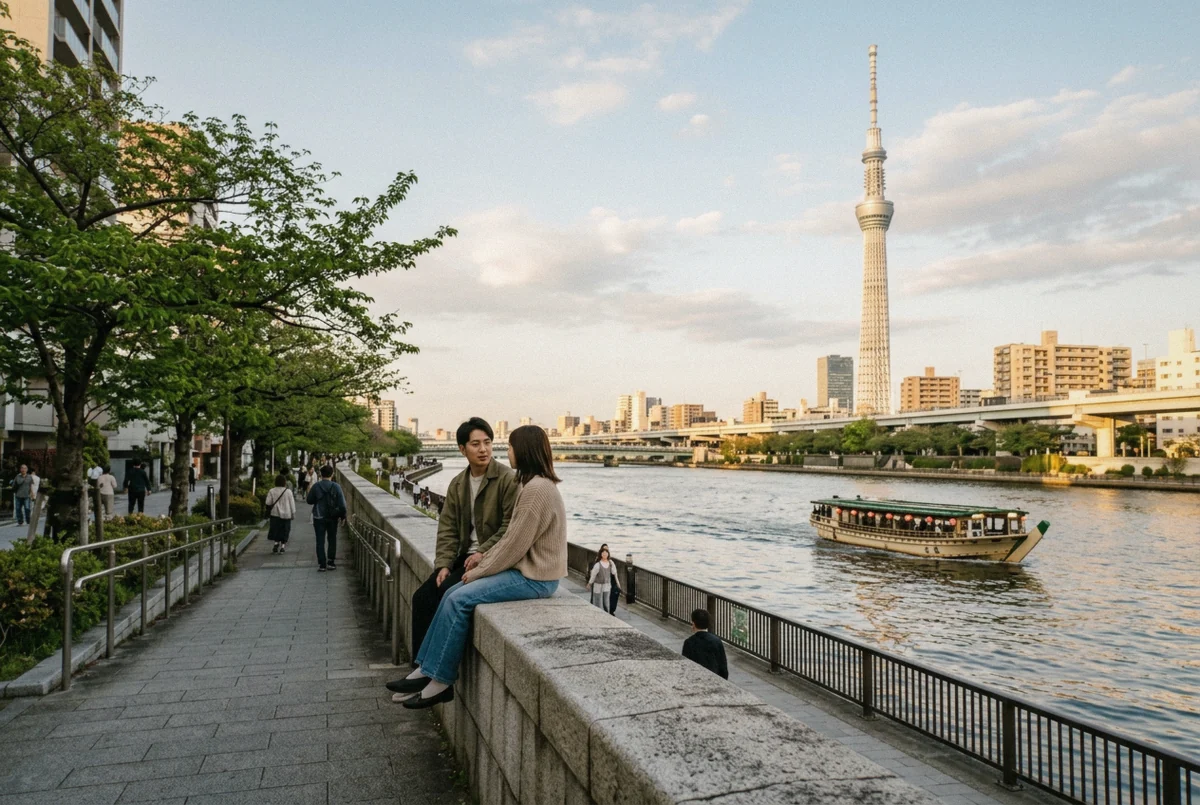
Sumida Park at the end of the day. The Skytree does the work; the river does the rest.
Best Light, Spot by Spot
Tokyo gives you two usable golden hours and one very short blue hour, and the districts want different ones. This is the shortlist.
| Spot | Best light | Why |
|---|---|---|
| Sensō-ji and Nakamise | 06:00 to 08:00 | Soft light, painted shutters, an empty approach |
| Nezu Shrine | Weekday morning | The torii tunnel is narrow; two visitors fill it |
| Yanaka Ginza | One hour before sunset | The sunset lines up with the steps at the west end |
| Meiji Jingu | First hour after opening | Low sun down the gravel avenue, few people |
| Chidorigafuchi | First light in bloom week | The boats start early and the crowd starts late |
| Shibuya Crossing | Blue hour, then after 22:00 | Screens lit while the sky still holds colour |
| Akabanebashi and Tokyo Tower | Blue hour | The only window where tower and sky both hold detail |
| Kabukicho and Golden Gai | Full dark | Neon needs black around it, not blue |
| Omoide Yokocho | From sunset | Lanterns on, grills lit, smoke visible in the light |
| Metropolitan Government Building | Sunset into blue hour | Glass reflections are worst while the room is lit |
The rain rule
Rain is an upgrade in the neon districts and a problem everywhere else. Wet asphalt doubles every sign in Kabukicho and Shibuya, which is why two of the photographers on this site advertise their night sessions as rain friendly and one describes light rain as the best conditions of the year. In Asakusa and at the shrines, the same rain flattens everything and puts a hundred umbrellas between you and the architecture.
If the forecast is bad and your dates are fixed, move the shoot to the neon and keep the temples for a dry morning.
One Day, Nine Spots, Hour by Hour
This is the route that gets the most out of a single day without doubling back across the city. Trains between the districts run every few minutes and no leg is longer than half an hour.
-
06:30
Kaminarimon and Nakamise
The gate, the lantern, and the shopping street with its shutters still painted and closed. Nobody in the frame and the light still low.
-
07:30
Sensō-ji and the pagoda
Incense smoke in the courtyard, the five storey pagoda with clean sky behind it, and the first visitors starting to arrive.
-
08:30
Sumida Park
Five minutes east to the river for the Skytree across the water, then breakfast before the district fills.
-
10:30
Nezu Shrine and Yanaka
The torii tunnel while it is still quiet, then the low rise streets of Yanaka on the way to Nippori.
-
13:00
Harajuku
Takeshita Street for colour and Meiji Jingu for the opposite. Both sit within five minutes of the station.
-
15:30
Shibuya
Center-gai and the backstreets in the afternoon, so you know the geometry before the light gets interesting.
-
17:45
Akabanebashi
Blue hour under Tokyo Tower. Twenty usable minutes, so be standing there before the streetlights come on.
-
19:00
Shibuya Crossing
Back for the screens at full strength, and the crowd at its most photogenic density.
-
20:30
Shinjuku
Kabukicho's gate, the Godzilla head, and the west exit crossing. If you want the lantern alley in the frame, book a session that has the alley's permission.
Where Tokyo Says No
Four restrictions matter for anyone photographing Tokyo seriously, and only one of them is widely known. Every one of these is public policy rather than folklore, and all four are worth reading before you plan a shoot around a location.
The two private alleys
Omoide Yokocho and Golden Gai are managed properties, not public streets. Omoide Yokocho's management prohibits any photography or videography, creative or editorial, without prior permission; the approval process issues an armband and assigns a staff chaperone. Golden Gai requires the approval of its business promotion association and posts camera crossed out signs at the lane entrances. Bar owners enforce it themselves and will ask you to stop or leave.
What that means in practice: a phone snapshot of a lane as you walk through is not what these rules were written for, and a tripod, a lighting rig or a posed portrait session absolutely is. If a lane appears on the itinerary of a session you are considering, ask the operator whether they hold the permission before you pay.
Shinjuku Gyoen bans commercial photography
The garden's own rules prohibit commercial photography and videography inside the grounds, and give examples: promotional shoots, photography for brochures or websites, and photographing models in order to sell the images. Groups may not exceed ten people including models, only hand held equipment is allowed, and stepladders, light stands and hand trucks are refused at the gate. During cherry blossom season and the chrysanthemum exhibition, tripods and reflectors are banned outright.
It is worth knowing because Shinjuku Gyoen is the first Tokyo location that international concierge photography services list. A paid portrait session inside those gates is precisely what the rule describes.
Formal and bridal costume narrows your options
Tokyo portrait studios warn that arriving in bridal costume significantly limits where a shoot can happen, because several gardens and parks restrict staged photography in formal dress. Rented kimono is a different matter and is welcome nearly everywhere, which is why the kimono sessions work the public streets of Asakusa rather than a garden.
Shibuya's street drinking ordinance
Since 1 October 2024 Shibuya ward has banned drinking on the street from 18:00 to 05:00, all year round, in the area around the station and Miyashita Park. The ordinance carries warnings rather than fines, but it changes what an evening scene in Shibuya can contain: a can in your subject's hand at nine in the evening is now against a local ordinance, and staff do approach people about it.
Which Session Reaches Which Spots
Eighteen of the thirty-two spots are covered by a bookable session. This is the join, taken from the operators' own itineraries and inclusions.
| If you want | Spots covered | Session |
|---|---|---|
| The crossing and the streets behind it | Shibuya Crossing, Center-gai | Shibuya neon tour |
| Only the crossing, quickly, for a group | Shibuya Crossing | Shibuya Crossing session |
| The neon lanes with a fast gallery | Kabukicho, Omoide Yokocho, Shinjuku Station, Golden Gai on the premium option | Cyberpunk neon session |
| The same lanes plus instant prints | Omoide Yokocho, Kabukicho, Shinjuku Station | Instax night shoot |
| Kabukicho and the Godzilla head | Kabukicho, Godzilla Head, Shinjuku Station | Kabukicho neon night |
| The 3D cat and midnight Shinjuku | Cross Shinjuku, Kabukicho backstreets | Shinjuku midnight session |
| The temple in a kimono | Kaminarimon, Sensō-ji, Nakamise, Asakusa side streets | Asakusa kimono walk |
| The temple and the river | Kaminarimon, Sensō-ji, Nakamise, Sumida Park | Asakusa temple and riverside |
| Two districts with commentary | Shibuya, Shinjuku, quieter side streets | Daytime portrait tour |
| To hold the camera yourself | Shibuya, meeting at Hachiko | Portrait photography workshop |
| Tokyo Tower with you in the frame | Zōjō-ji gate, Shiba Park, the tower base | Tokyo Tower photoshoot |
| Tower viewpoints, your own camera | Three tower viewpoints, Atago Shrine | Hidden tower viewpoints walk |
The fourteen spots nobody sells
Shibuya Sky, Nonbei Yokocho, Takeshita Street, Meiji Jingu, Shinjuku Gyoen, the Metropolitan Government observatory, the Culture Centre terrace, Hoppy Street, the Skytree, Chidorigafuchi, Nezu Shrine, Yanaka Ginza, Kagurazaka and the Rainbow Bridge have no session on them. Part of that is regulation, as at Shinjuku Gyoen. Most of it is simply geography: the bookable sessions concentrate in four districts because that is where their photographers work, and the rest of the city is yours on foot.
The full field, with what each session includes and how fast the photographs arrive, sits in the comparison table.
Tokyo Photo Spots: Questions People Ask
What are the most photogenic places in Tokyo?
Shibuya Scramble Crossing at blue hour, the Kabukicho neon strip after dark, the lantern alley of Omoide Yokocho, Sensō-ji and Nakamise before eight in the morning, Tokyo Tower from the Akabanebashi crossing, and the torii tunnel at Nezu Shrine. All thirty-two spots on this page are on the map with their coordinates and best light.
What are some good spots to take pictures of Tokyo Tower?
Four vantage points cover it. The Akabanebashi crossing, where the tower rises straight up the middle of the road. Zōjō-ji's main hall, for the temple and tower composition. Shiba Park directly below, for the legs and the underside. And the Roppongi side, where the tower sits inside the skyline. Blue hour is the only window where the lit tower and the sky both hold detail. Two sessions work this cluster: one with a photographer, and one where you carry the camera.
Can you take photos in Omoide Yokocho and Golden Gai?
Not without permission. Omoide Yokocho's management prohibits all photography and video without prior approval, and approved shoots wear an armband and are accompanied by staff. Golden Gai requires the business promotion association's approval and posts no photo signs throughout. Two sessions on this site list those lanes as stops, so ask the operator how the stop is handled. What the rules cover.
What time should you photograph Sensō-ji?
Before eight in the morning. The approach is nearly empty, the light is soft, and Nakamise's shutters are still down and painted, which makes a corridor of colour with nobody in it. After ten it becomes crowd management. The temple grounds are open all day and the main hall opens at 06:00, or 06:30 in winter.
Do you need a permit to take photos in Tokyo?
Not for ordinary photography on public streets. Permission is required in privately managed spaces, and three matter here: Omoide Yokocho, Golden Gai, and Shinjuku Gyoen, which prohibits commercial photography inside the garden altogether. Professional film shoots on public roads need a police permit, which is the operator's problem rather than yours on a walking session.
Which Tokyo photo spots work in the rain?
The neon ones, and they work better. Wet asphalt reflects every sign in Kabukicho, Shibuya and the Shinjuku backstreets, which is why two photographers on this site sell their night sessions as rain friendly. Temples and gardens are the opposite: flat light and umbrellas in every frame. If the forecast is poor, swap the order of your days rather than cancelling.
Is a photoshoot in Tokyo worth booking, or should you shoot it yourself?
It depends which frame you want. The city photographs well on a phone, and fourteen of the spots here have no session on them anyway. What you cannot do alone is be in the picture, lit properly, in the middle of the scramble crossing at blue hour. That is what the sessions on the Tokyo photoshoot comparison are selling, from thirty five dollars for a shared hour in Shinjuku upwards.